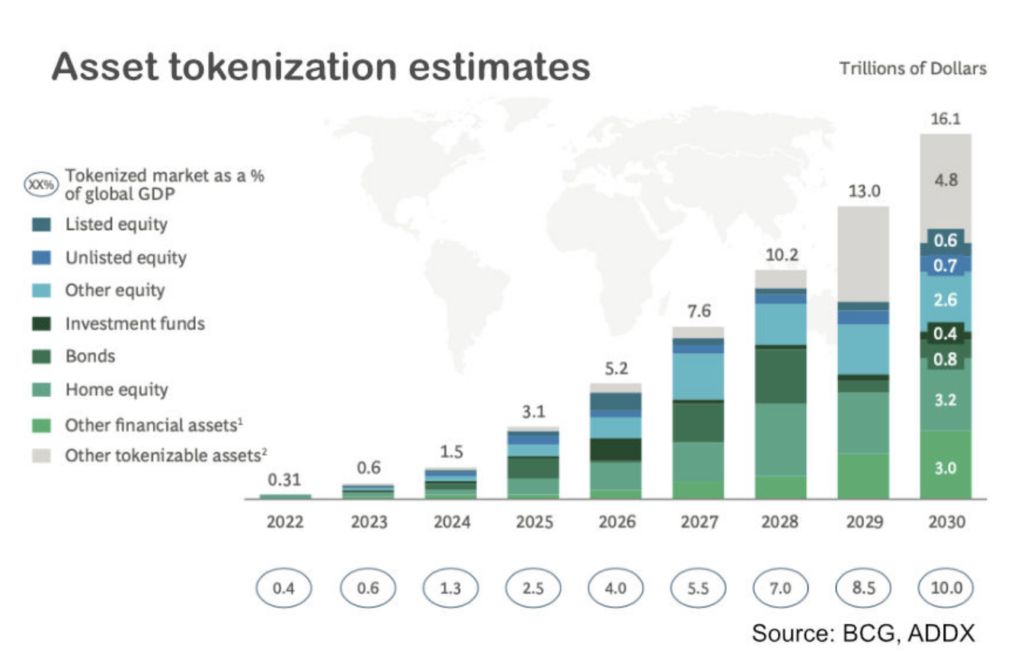
The global financial landscape stands at an unprecedented inflection point. With over 185 crypto tokens classified as Real-World Assets and their market capitalization exceeding billions of dollars now, representing a regular month on month over 50% increase, we’re witnessing the early stages of what industry experts predict will be a $30 trillion asset tokenization market by 2030.
Challenges in Traditional Lending
Traditional lending infrastructure, despite its robustness, operates with inherent limitations that blockchain technology can address. Current systems rely on intermediate processes that can take weeks for settlement, involve multiple verification parties, and operate within isolated systems that limit global capital mobility.
In our daily operations at Vayana, we encounter scenarios where an Indian exporter seeking working capital against receivables from a European buyer must navigate multiple banks, correspondent relationships, documentary verification, and manual reconciliation processes. This complexity translates to higher costs, extended settlement times, and limited access for smaller enterprises.
Traditional vs. Blockchain Lending
How Blockchain Transforms Lending
Blockchain technology fundamentally reimagines lending through three core innovations: programmable digital assets, automated verification, and global accessibility. When real-world assets are converted into digital tokens on blockchain networks, they become programmable representations that can be instantly transferred, divided into smaller portions, and used as collateral across global digital lending platforms.
What we know about the Leading Market Players and Success Stories
1. Ondo Finance: Institutional Asset Management
Ondo Finance has emerged as the second largest issuer of tokenized U.S. Treasuries, with U.S. Dollar Yield (USDY) and Short-Term US Government Bond (OUSG) tokens standing at $385 million and $268 million market capitalization, respectively. In February 2025, Ondo Chain was officially launched, providing institutions with a secure, compliant platform for converting traditional assets into digital tokens.
Ondo’s approach centres on tokenizing stable, income-generating assets from traditional finance, merging reliability with blockchain efficiency. By May 2025, over $1.1 billion worth of government treasuries had been tokenized on Ondo Finance, demonstrating institutional confidence in blockchain-based asset management.
2. Circle: The Stablecoin Infrastructure Leader
Circle’s transformation from a Bitcoin payments company to a major digital currency infrastructure provider exemplifies blockchain finance evolution. Circle completed its public listing in June 2025, raising $1.1 billion and achieving a valuation of $6.9 billion. Over $25 trillion in transaction volume has been processed using USDC, their digital dollar equivalent.
By early 2025, business-to-business stablecoin transactions accounted for $36 billion, surpassing peer-to-peer uses. This growth reflects increasing adoption of digital currencies in traditional business operations, particularly in regions with less reliable banking systems.
3. MakerDAO: Bridging Traditional and Digital Assets
MakerDAO has successfully expanded beyond cryptocurrency collateral by integrating real-world assets, including corporate bonds and trade finance instruments. This diversification strategy has enhanced their digital currency (DAI) stability while accessing multi-trillion-dollar traditional asset classes.
Technical Infrastructure Made Simple: How Blockchain Platforms Are Solving Complexity for Financial Institutions
Digital Asset Verification Systems
Real-world asset valuation requires reliable external data sources, presenting a key technical challenge. Leading platforms use multiple data sources to ensure accurate valuations, like how financial markets use multiple price feeds for stock valuations.
Risk Management in Digital Lending
Blockchain lending platforms employ several risk management strategies, some of which are as follows:
Regulatory Progress and Compliance
The regulatory landscape continues evolving rapidly, with jurisdictions worldwide developing frameworks that balance innovation with investor protection. The European Union’s Markets in Crypto-Assets (MiCA) regulation and Singapore’s progressive stance provide the regulatory clarity institutional players require.
Modern compliance systems incorporate privacy-preserving technologies that enable regulatory reporting while maintaining transaction privacy, like how banks protect customer information while meeting regulatory requirements.
Cross-Platform Integration
Modern asset tokenization platforms prioritize compatibility across different blockchain networks to maximize capital efficiency. Circle and Ripple’s partnership, bringing USDC to the XRPL blockchain, demonstrates the importance of interconnected systems, enabling seamless financial applications across platforms.
Integration systems connect traditional banking with blockchain protocols, enabling smooth asset tokenization and management without requiring banks to completely overhaul existing systems.
Future Market Developments
The convergence of several trends will accelerate real-world asset adoption:
Central Bank Digital Currencies (CBDCs) : Government-issued digital currencies providing regulated infrastructure
Bank Digital Tokens: Traditional bank-issued digital representations of deposits Privacy-Preserving Compliance: Systems that maintain privacy while meeting regulations AI-Enhanced Risk Assessment: Improved credit scoring and risk management
Implementation Guide for Financial Institutions
1. Technology Assessment
Financial institutions should evaluate blockchain platforms based on transaction speed, security features, and regulatory compliance capabilities. The goal is to identify systems that complement rather than replace existing infrastructure.
Proactive engagement with regulators ensures compliance while exploring innovative applications within existing frameworks. This includes implementing systems that preserve privacy while meeting reporting requirements.
2. Operational Integration
Developing connections between existing banking systems and blockchain platforms enables seamless asset tokenization without disrupting current operations. This includes establishing partnerships for real-time asset valuation and implementing appropriate risk management frameworks.
What’s in it for the Financial Institutions?
The convergence of regulatory clarity, technological maturation, and institutional adoption creates unprecedented opportunities for traditional financial institutions to enhance lending capabilities while expanding access to global capital markets. The question remains: will your institution lead this transformation or follow in its wake?
The migration of real-world assets to blockchain represents a fundamental reimagining of global capital markets. With institutional players like Ondo Finance tokenizing over $1.1 billion in treasuries and Circle processing over $25 trillion in transactions, momentum is building rapidly.
The traditional finance market — a multi-trillion-dollar ecosystem- is not asking if blockchain will integrate, but how fast. The early adopters will be the ones to shape the next era in global finance.
The traditional finance market that ranges in trillions of dollars stands ready for blockchain integration. Financial institutions must decide not whether this migration will occur, but how quickly they will adapt to leverage these capabilities.
At Vayana, we facilitate over $1.5 billion in Trade Finance Loans monthly across 20 banks in India. We witness firsthand how emerging technologies like blockchain, tokenization, and digital currencies are reshaping traditional lending. Our commitment to facilitating growth for deserving MSMEs and micro-entrepreneurs aligns with blockchain’s promise of democratizing access to global capital markets.
Written by Manish Gadia, Head of Emerging Technologies at Vayana, a leading trade finance platform that has facilitated over USD 45 billion to date. Known for driving innovation in fintech, Manish blends practical finance expertise with cutting-edge technology.